Project Latest News
After years of planning, work to the church started in 2014. This page has kept a running record of progress ever since.
2023
August 2023: after yet more delays, the hospitality extension is almost completed. The new toilets and kitchen are in use, and we expect the few small remaining aspects to be finished soon!
2021–2022
November 2021: a new main contractor, BnB IT Solutions, was appointed and started work in October. Good progress was being made, but delays with some key materials meant completion was not likely until June 2022.
August 2021: unfortunately we had to part company with our main contractor in July, and we were soon to appoint a new contractor to complete the extension works.
February 2021: the main contractor, Ashfield Building Group, started on site on 1st February. The foundations were dug for the new extension, which was to house an entrance lobby, a small commercial kitchen, three toilets (including disabled and infant/baby change facilities), a cleaner’s cupboard, and a link to the old building via the reopened North Porch. Completion was expected by late June 2021.
2020
August 2020: some really good news — we believed we now had all the money raised for Phase 4, the building of the planned extension for toilets and a kitchen. The last two grants were confirmed recently: £30,000 from North Lincolnshire Council’s Community Grant, and just over £73,000 from the FCC Community Action Fund (previously known as WREN). Winterton PCC was very grateful indeed for both grants.
The planned budget for Phase 4 was £286,000. We had raised £186,000 in grants and pledges, and saved a further £100,000 in PCC project accounts and reserves. We then awaited tenders from contractors to see if the money raised was enough. The funds already raised would let us fit out the kitchen with the main appliances, but we would still need to find the money for all the kitchen utensils, so we asked people to consider making a donation to the chair scheme (see Sponsor a Chair!), as all such donations go directly to the fund.
April 2020: a successful grant application brought a further £20,000 to the budget for the planned extension, though the tender documents could not be issued due to the shutdown.
March 2020: much had happened over the previous 12 months to consolidate the activity programme and deal with issues arising from the changed building. We revised the plans for the new extension (toilets and kitchen) and made several grant applications, all made by this point, with outcomes awaited between then and June. We planned to issue tender documents in late April, so that work could start on site in July if the grants allowed.
2019
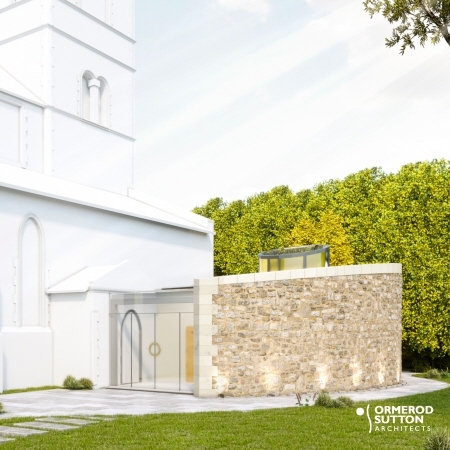
March 2019: the Heritage Lottery Fund (now renamed The National Lottery Heritage Fund) section of our project ended this month. We celebrated the end of this successful partnership on 22nd March with John Williams, who represented the National Lottery Heritage Fund Committee for Yorkshire and the Humber, in the presence of the Bishop of Grimsby and the Mayor of North Lincolnshire. At the evening event, our architect, Armine Sutton, presented the image of the Phase 4 kitchen and toilet extension, which had yet to be completed, so the fund-raising continued.
2018
November 2018: at long last the churchyard paths reopened to the public. They had been closed in 2015, as stone was falling from the tower walls onto the path below. A walkway had been erected to allow safe access to the main door. Negotiations for the money needed took far longer than expected, but the repairs to the tower were recently completed. Special thanks were given to our volunteers for dismantling the walkway and gate barriers — the timber was to be re-used for storage shelving at higher levels in the tower — and to our tower clock keepers, who spent much time cleaning the mechanism of the tower clock before it could be restarted after the building works. So the church and churchyard began to return to normal.
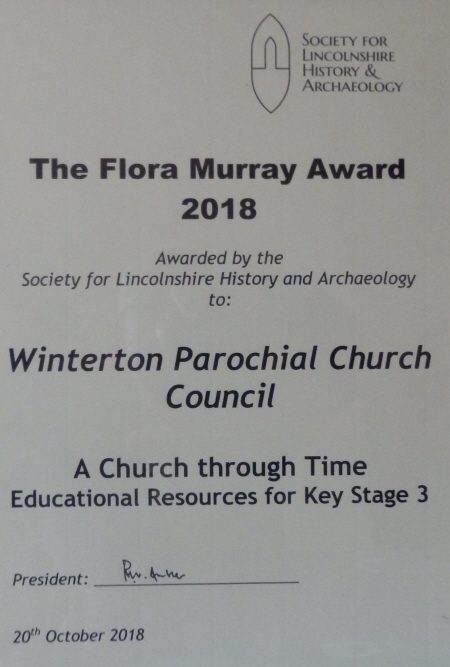
October 2018: it was announced at the AGM of the Society for Lincolnshire History and Archaeology that Winterton PCC was the winner of the 2018 Flora Murray Award. This accolade was for the educational work which the PCC arranged as part of the Heritage Lottery Fund project. Some of the project’s activity plan funding was used to commission Heritage Lincolnshire to work with all three Winterton schools to prepare lesson materials for pupils to use in the church, with the award picking out work planned for Key Stage 3 at Winterton Academy.
September 2018: most of the work on the tower external walls was nearly complete, and the tower scaffold was being dismantled. Once removed, the scaffold holding up the roof inside the Parish Room and the Heritage Room could also come down and the two rooms return to normal. The tower roof had already been renewed. The window conservator had measured the new stone tracery in the South Transept gable window, and the leaded glass panels were to be fitted back in September, with further internal decoration to follow before the end of the month.
Work still to be completed inside the tower included a new ladder system, safety rails and storage shelves. The graveslab lintel would not be put back over the tower door by the conservator until October. The new church noticeboard had been fitted in the South Porch, and one for the churchyard would soon be erected. The churchyard paths were to be reopened as soon as the walkway was dismantled, and the old compound dismantled as the remaining stone had been moved to new compounds on the north side of the church.
July 2018: after many problems with the tower scaffolding and stone for the window tracery, work was proceeding apace. Most of the church interior had been redecorated, some ledger stones reinstated, and the external rainwater drainage system renewed. The external tower walls were being raked out and remortared, the tower roof was soon to be replaced, a new internal HSE ladder system installed, and various other items completed. It seemed the work might be finished and the churchyard reopened by later August or early September.
February 2018: the Phase 3 work was expected to start on site in late March and to last until early July 2018, after which the works below would be completed and the churchyard reopened at last.
2017
December 2017: the Heritage Lottery Fund extended our grant from £748,100 to £996,000. This increase of £247,900 allowed us to carry out the urgent repairs still needed and complete the reordering inside the church. The funding included the following work:
- Tower: new roof lead and gutters; repair/renewal of stone pinnacles and parapet wall; significant repointing and stone renewal to external walls, plus refixing the tower clock face; repair to wooden bell opening louvres; internal wall paint removal and partial redecoration; a new HSE-compliant roof ladder and hatch grab rails; renewal of the lightning conductor; re-installation of the grave slab internal lintel to the west door.
- External: dismantling of the timber walkway and gate barriers so the churchyard paths could reopen; renewal of the perimeter drainage channel as advised by Historic England; renewal/repair of the South Transept gable window tracery and mullions, with leaded window panels reinstalled from store with steel screen protection; installation of tell-tales on the east, north and south gables to monitor the structure; removal of the compound on the north side of the churchyard; new signs.
- Internal: completion of internal decoration to ceilings and walls; re-installation of some ledger stones in the Chancel; renewal of curtain rails and curtains at external doors, with draughtproofing to doors.
It was anticipated that the work would commence in March 2018, once warmer weather allowed cutting of the tracery stone needed. Funding for the planned toilet and kitchen extension was not to be provided by the HLF; the PCC would attempt to cover this from other grant sources as soon as possible.
August 2017: our new architect re-examined the plans in detail to try to find cost savings. A fresh round of tender applications for the construction work took place in late spring to test commercial prices again, leading to a new approach to the Heritage Lottery Fund for an extended grant, with an on-site meeting to discuss this planned for September.
2016
December 2016: disappointing news that our GPOW grant application, made in August, was not successful. The PCC had to find a new way forward to secure the funding needed.
October 2016: Historic England (formerly English Heritage) placed All Saints’ Church on the national Heritage At Risk Register, as their inspections had revealed “poor condition of the tower and chancel stonework, the poor structural condition of the south transept window, poor below-ground drainage arrangements and general stonework repointing needs”. The church council already knew these details and had been working to raise the money to carry out these repairs. This news was expected to help the PCC by alerting those authorities who make grant decisions that our church had a national priority to acquire funding to address these repairs, so that our ‘irreplaceable’ church could be made ‘safe and sustainable for future generations’.
August 2016: a GPOW (Grants for Places of Worship) application was made to the Heritage Lottery Fund to repair the tower walls, the South Transept gable window tracery, and the perimeter drainage channel. The outcome was expected in December, with a Stage 2 application to follow in February 2017 if successful. Further grants were also being sought to complete the toilet/kitchen extension and finish the work inside the church. It was clear that no new work could start before July 2017 at the earliest, and, if so, might still be completed by the end of 2017.
July 2016: the PCC appointed Armine Sutton of Ormerod Design Ltd as our new project architect. She ensured our updated faculty application to the Diocese was made by the July deadline, and we were optimistic that the Diocesan DAC would agree with the modified scheme.
June 2016: our architect, Brian Foxley, who had worked so hard for our project and designed a superb kitchen/toilet extension, died suddenly in early June. The PCC expressed condolences to his family, and set about appointing a new architect to keep the remaining work on schedule.
May 2016: during the works, new repair issues were discovered which had not previously been identified — stones falling off the external tower walls, and rotten stone tracery in the South Transept gable window. In addition, the new extension for toilets and a kitchen was not completed, owing to funding issues. Lengthy discussions took place to try to resolve the funding issues, with hopes that the remaining works would start in late 2016 or early 2017.
2015
September 2015: the main construction work was completed on 18th September and the church returned to normal use, though a number of small works remained to finish, and the extension for the new toilets and kitchen was yet to be built. The church was open for the national Heritage Open Days on 12th/13th September for some 180 visitors.
June 2015: 22nd May did not prove possible for completion due to delays, but we had an amazing Open Day on 25th May, when over 978 visitors came to see the church in just over four hours. By this point the paving was completed, and much work had been done on the new mezzanine floor in the tower. The new furniture and the restored pipe organ were almost all fitted, and the new chairs delivered. Some heating, electrical and IT network work remained to be finished. Sunday services resumed in the church from 12th July.
April 2015: the planned completion date in late April was put back to 22nd May, owing to delays in the delivery of paving stone and other sub-contracts. However, the doors opened to the public on 25th May as planned, with safe entry across the churchyard to the South Porch. Apart from completing the floor and the tower, there remained fitting the new furniture, delivering the chairs, refitting the pipe organ, and re-fixing the medieval stone fragments, among much else.
March 2015: construction of the plant room started outside the north-west corner of the church. A new mezzanine floor was soon to be fitted inside the tower, and the tower screen was moved to its new location as part of the partition for the Heritage Room.
January 2015: the main frame for the pipe organ was reinstalled in the Vestry/Organ Chamber, so that the new organ chamber partition could be erected, allowing more space for the Vestry (with some organ components repositioned to take up less space). New electricity wiring was installed throughout, with a new IT cable network, and a start was made laying the network of heating pipes across the surface of the limecrete floor, ready to be covered with screed and, eventually, the new stone paving.
2014
December 2014: Churchside saw many delivery lorries in recent weeks, blocking the road, as huge amounts of glass insulation and limecrete were brought onsite to form the base of the new floor in the nave, aisles and transepts. This was left to dry out over Christmas so that work could continue in January.
November 2014: the floor of the nave, aisles, transepts and tower was dug by the archaeology team. The foundations of a large building, almost as big as the present church, were found; it was unclear whether this was Saxon or later, but clear that it was earlier than the medieval walls of the current church. The loose bones found, and the one skeleton unearthed under the tower floor, were all re-buried by our Vicar. Work continued on the ducting for the underfloor heating system and electric cables, and new wooden floors were installed in the Parish Room and the old Choir Vestry (to become the new Heritage Room). A photo record of all these stages was being made so that a full picture of the project could be seen later.
October 2014: the Phase 1 works (roof and fabric repairs, new rainwater goods) were completed, and Phase 2 (internal works to reorder the space, with new floor, heating, lighting, sound, Heritage Room, seating and redecoration) started.
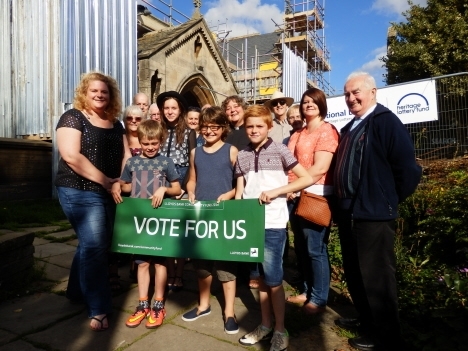
September 2014: All Saints’ was selected as one of four projects by the Lloyds Bank Community Fund. Public voting between 2nd September and 10th October would determine how the four prizes were allocated.
August 2014: a copy of the Project Information Board prepared for the construction site is available to download below. An Estuary TV news bulletin (Thursday 21st August) featured an update on the project and interviews with Harry and Max, in the middle of the bulletin between 5 minutes 53 seconds and 8 minutes 57 seconds, on YouTube.
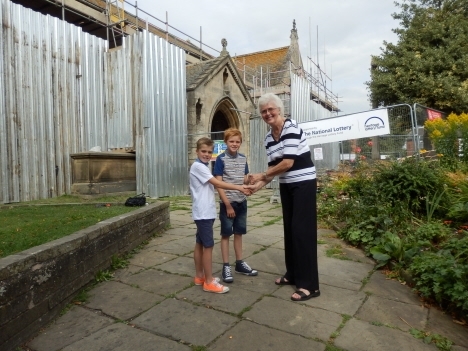
Winterton’s Budding Bakers Help All Saints’: Mary Berry would have been proud of Winterton’s budding bakers, Max (9) and Harry (7) Moody, who arranged a stall at their home on Northlands Road on 3rd August to sell cakes they had cooked themselves, along with loom bands they had woven. Their mother, Terri, confirmed it was all their own idea — she explained that keeping a commitment to play football meant they had missed a coffee morning held in aid of the church at their grandparents’, so the two enterprising brothers decided to make their own effort to help by raising money for the repair and development project. Their stall made a total of £36, which they handed over to the church. Jean Key, churchwarden, thanked the two brothers for their superb effort, saying they had “set a fantastic example to other young people”. Behind them, the church was swathed in scaffolding and sheeting, ready for the new roof repairs and rainwater goods.
July 2014: Aura Conservation Ltd were appointed as main contractor for Phase 1 of the capital works, arriving on-site on Tuesday 29th July for eight weeks to complete roof and fabric repairs, fit new rainwater goods, and lift the nave floor to allow internal archaeology to commence. Conservators removed the South Transept gable window for extensive repair and repainted the tower clock face. Phase 2 works were being refined so that a start could be made soon. Faculty No. 3, for the extension and internal reordering, was received, and new tenders for Phase 1 were received, with work due to start in late July. A start was made on-site with conservation of stone memorial tablets and stone fragments.
June 2014: main contractor tenders were re-issued to new companies, and the project was split into phases to meet grant deadlines while the final faculty was still awaited. Significant fund-raising continued for certain aspects of the project, and the parish bier and west gallery instruments were removed for conservation.
May 2014: planning permission for the new extension was granted, and main contractor tenders were received, with negotiations on the price under way.
April 2014: the 19th-century pipe organ, an oil painting and the old reredos panels were all removed for restoration. The church was emptied of remaining furniture, which went into temporary storage, and a final auction of pews and commercial sale of the remainder took place.
March 2014: Faculty No. 1 (conservation works to archives and artefacts) and Faculty No. 2 (roof repairs) were granted.