Church Clock
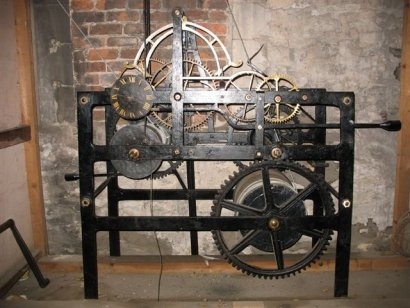
The Winterton church clock was made in 1834 and its original mechanism still functions today, wound and maintained by hand every week.
History
The clock was made in 1834 as a joint effort by local clockmaker John Robinson and blacksmith Matthew Beacock, confirmed by the inscription on the pendulum bob: “Nov. 1 1834 J Robinson and M Beacock fecit”. John Robinson had married into the Tate family, who ran a business in Winterton, including clock repairs, until 1987 — so from 1834 until 1987 the clock was wound and maintained by the Robinson and Tate families. Since 1988 John Ablott has been Clock Keeper.
The old hemp ropes to the weights were worn and were replaced by steel wire ropes in May 1988. In 1993 the cast brass third wheel of the striking train broke, having previously failed many years before and been roughly repaired by brazing; a new wheel, machined from a blank sawn from a 9-inch diameter solid brass bar, was fitted in May 1994. Perhaps as a result of this earlier failure, a further disaster occurred in August 1995, when the “fly” (which regulates the speed of the striking) failed, causing much damage.
How It Works
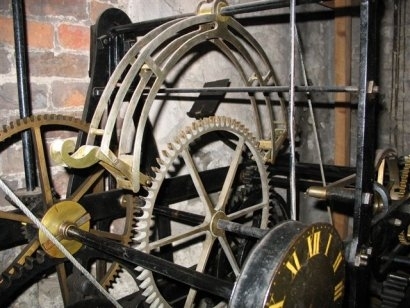
The clock movement is of wrought-iron plate and spacer construction, with the timekeeping train to the left and the striking train to the right. The great wheels are cast iron, with cast brass wheels further up the train. Timekeeping is controlled by a 13-foot-long pendulum beating two-second intervals, coupled to a “dead-beat” escapement which is unique in having pivoted roller pallets acting on the 16-inch diameter escape wheel. The time is shown externally on a single cast iron skeleton dial approximately 5 feet in diameter. The hour striking on the tenor bell is controlled by a locking plate.
Winding the Clock
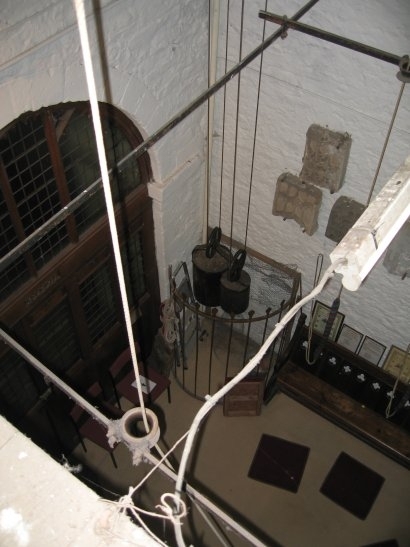
The clock is wound by hand, raising the weights up 35 feet every week. The weight for the timekeeping train is approximately 3cwt, and that for the striking train about 7cwt.
Based on information supplied by John Ablott (M.B.H.I.).
If you would like to find out more about church tower clocks in general, see The Turret Clock Keeper’s Handbook, published by the Antiquarian Horological Society.