Church Organ
Our church pipe organ was first installed in 1840 by Beeforth & Corbett of Hull — the first pipe organ to be introduced by a church in this area.
According to Credland’s Almanack for 1912, the organ came about because of the “unsatisfactory conduct and irregular attendance at the services” of the West Gallery musicians who had until then provided music for services. This “caused Mr. John Barratt, one of the Churchwardens, to decide upon having a change, and he called upon Mr. Godfrey Robinson to assist him in collecting funds for an organ. They were only partly successful. However, an order was given to Messrs. Beeforth & Co., Hull, and an instrument erected in the gallery at the west end during the year 1839.”
Great difficulty was experienced in raising the funds, as they relied on the help of Lady Boynton, but her ladyship refused to subscribe as she had already contributed largely to the church clock made in Winterton by Messrs. Robinson & Beacock at a cost of about £100. Organs were few and far between at that time, the nearest being at Hull and Lincoln, so many visitors came from neighbouring villages to hear it.
An amusing incident is recorded from one such visit: three ladies from Thealby called upon Mr Robinson and asked him to give one of his organ recitals. On his way to the church he met a young man named George Drax, “a bit of a character”, and invited him to blow for him. After ascending the organ gallery, the organist took his seat and fingered the keys, but no sound came. After repeated calls to George to blow, with no result, he had at last to leave his seat and look round, and on asking George again why he did not blow, he replied “I can’t find a hole to blow into” — George had evidently expected the instrument to be played the same way as some of the wind instruments he knew. The wooden handle used to blow the organ can still be seen, though it is now kept in the Vicar’s Vestry at the back of the organ case; the organ blower is nowadays usually operated by electricity.
A Moving Instrument
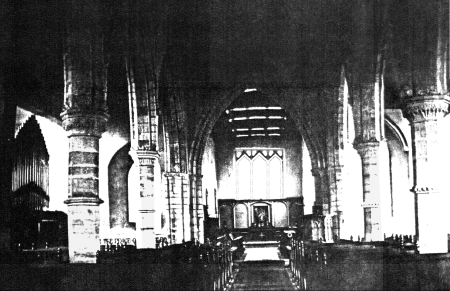
In 1872 T H Nicholson moved the organ to the North Transept — you can see the pipe organ on the left in the photograph below. Then in 1884 Forster and Andrews rebuilt the organ and moved it to its current location in the Chancel.
The Specification
Details of the pipe organ’s stops:
| Division | Stop | Pitch |
|---|---|---|
| Pedal | Lieblich Bourdon | 16 |
| Pedal | Flute | 8 |
| Great | Open Diapason | 8 |
| Great | Rohr Flute | 8 |
| Great | Flute | — |
| Great | Principal | 4 |
| Great | Gamba | 8 |
| Great | Fifteenth | 2 |
| Swell (enclosed) | Open Diapason | 8 |
| Swell (enclosed) | Lieblich Gedact | 8 |
| Swell (enclosed) | Principal | 4 |
| Swell (enclosed) | Mixture | — |
| Swell (enclosed) | Horn | 8 |
| Swell (enclosed) | Oboe | 8 |
Data copied from the British Institute of Organ Studies. National Pipe Organ Register (NPOR) reference: D04370, Version 3.1.
From the Parish Magazine Archive
- January 1901: The organ has been repaired and cleaned at a cost of £47.7s.3d.
- December 1907: Dedication Festival one of the happiest yet, although the organist had some difficulty as two notes went wrong just before the service.
- November 1908: Organ recital and musical service with violin accompaniment.
- March 1962: Collection of money for an organ started in 1935.
- October 1962: Organ in church needs overhaul and repairs — cost about £500.
- August 1964: All Saints’ organ now back in use.
- April 1978: Mr Harry Hall continues as organist after 50 years in the post.
- March 1982: 80-year-old Harry Hall, organist at All Saints’ for many years, is recovering slowly from illness. A stand-in volunteer would be very welcome temporarily.
Unfortunately, we do not currently have a permanent organist. There is a digital organ located in the nave, but this is privately owned.
Data copied from the British Institute of Organ Studies — see the BIOS website.