West Gallery Instruments
All Saints’ holds a rare surviving collection of six West Gallery instruments, once played by a village band that led worship before the church had an organ.
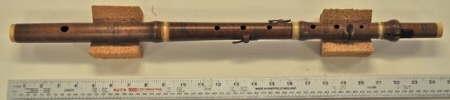
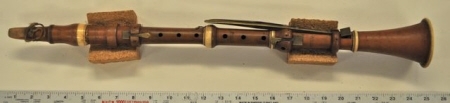
All Saints’ has a collection of six West Gallery instruments, some of the original instruments played by Winterton people who made up a band providing music in the church before the first organ was purchased in 1840. They are on view in a dedicated display case in the Heritage Room at the church. The collection was professionally conserved, and we are most grateful to the Charles Hayward Foundation for providing a grant to fund the conservation of these instruments. We are unaware of any similar, extensive West Gallery instrument collection with contemporary sheet music in the UK original to the church in which it was used.
The Instruments
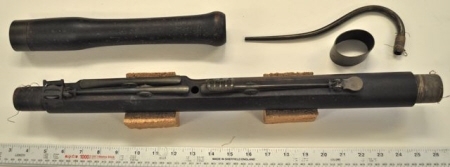
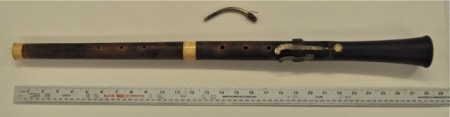
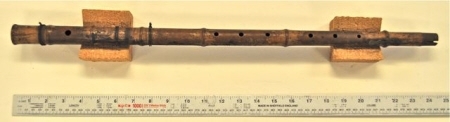
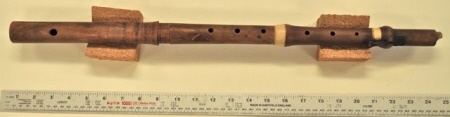
This rare collection of West Gallery wind instruments includes a bassoon by Milhouse of London, c.1800 — only fragments survive, comprising the bell joint, the bass joint, the crook and a brass ferrule of the boot joint; the wing joint and boot joint are both missing. A three-keyed vox humana by Milhouse of Newark, c.1763–1788, a very unusual instrument for a church band, resembles a tenor oboe and is complete with two keys and staple, jointed in two sections. A one-keyed walking-stick flute, made to imitate a bamboo walking stick, about 1790, maker unknown — the main body survives but it is missing its cork, cap and bottom ferrule; it is made in one section with one key. A one-keyed boxwood flute, possibly by Milhouse of London, c.1790, is in four joints with one key, missing two ivory ferrules, an ivory cap and a leather keypad. A four-keyed boxwood flute by Phillips is in four joints with four keys and four ivory ferrules and an ivory cap; two of the keys are broken and parts are missing. A five-keyed clarinet in C, boxwood and ivory, by Metzler, c.1800, has three main body joints with a separate bell and a mouthpiece integrated with the barrel; it has five keys and appears to retain an early — possibly original — reed. The photographs above and condition notes are taken from a conservation report commissioned by the church from Andrew Lamb, Manager of the Bate Collection at the University of Oxford.
Sheet Music and Manuscripts
There is also, in our archives, contemporary sheet music which was used with these instruments in All Saints’ until the mid-19th century. The secular music sections of this manuscript have been transcribed into modern musical notation by Ruairidh Grieg; you are welcome to download and use this manuscript, but please make reference to its source. In due course we plan to transcribe the non-secular music as well.
Another manuscript volume was kindly donated to us by Sue and Adrian Carlton, who discovered it in East Anglia. The volume bears the name Amelia Harrison, who lived in Winterton in the 19th century. For full details, see winterton.treewind.co.uk, where the music has been transcribed to ABC notation by their friend Anahata; the website also holds PDF and MIDI files together with data about Amelia Harrison.
- Winterton Church ManuscriptSecular music transcribed to modern notation (PDF)
- Introduction to West Gallery MusicBackground reading (PDF)
What is West Gallery Music?
A very clear outline of this music, common in English churches in the 18th and early 19th centuries, and its significance, is given at rodingmusic.co.uk. There is a huge amount of detail about West Gallery Music on the website of the West Gallery Music Association at wgma.org.uk, and also at psalmody.co.uk.
What is a West Gallery?
Many churches had a west gallery, so called as it was located at the west end of the nave. In All Saints’ there was a gallery erected in 1754 against the tower wall at the west end of the nave; it was not taken down until 1872. Much information about churches with west galleries can be found at westgallerychurches.com.
West Gallery Music in Winterton
According to Canon Fowler’s notes in the 1912 edition of Credland’s Almanack, in the 1830s at All Saints’: “The Choir at the time occupied the gallery at the west end of the church, the instruments used being a flute, bass fiddles, bassoon, and a clarinet; these were played by Messrs T. Wilson, G. Nassau, L. Phillipson, W. Tock, and P. Jolly. The vocal members were Messrs T. Robinson, R. Pearson, and R. Michaelwaite. The latter was one of the Churchwardens, and used to announce the number of the hymns or Psalms in such a faltering voice as was scarcely audible. After several complaints, a notice board was affixed in the centre of the gallery, with hymns on one side and Psalms on the other, the number being indicated by movable figures. The conductor of this unique choir gave great offence to one of the violin players by always looking at him when any mistake was made, and he threatened to give the conductor a smart switch with his bow if he ever dared to turn round again when a mistake was made, as the congregation thought that he alone was the cause. Their unsatisfactory conduct and irregular attendance at the services caused Mr John Barratt, one of the Churchwardens, to decide upon having a change, and he called upon Mr Godfrey Robinson to assist him in collecting funds for an organ. They were only partly successful. However, an order was given to Messrs Beeforth & Co., Hull, and an instrument erected in the gallery at the west end during the year 1839.”
Many churches in the 19th century ended the West Gallery tradition and installed organs (see our Church Organ page). At All Saints’ the gallery was not taken down until 1872, although the first organ was purchased in 1840, so there may have been an overlap period when both musical traditions were in place. West Gallery music events are held in our church from time to time.